Ayurvedic treatment for Frozen Shoulder in Dubai
Ayurvedic treatment for Frozen Shoulder in Dubai: Holistic Joint Care in Bur Dubai
Frozen shoulder is a painful condition that gradually restricts movement of the shoulder joint. Also known as adhesive capsulitis, it can make everyday activities such as dressing, washing the hair, reaching overhead, driving or sleeping comfortably increasingly difficult.
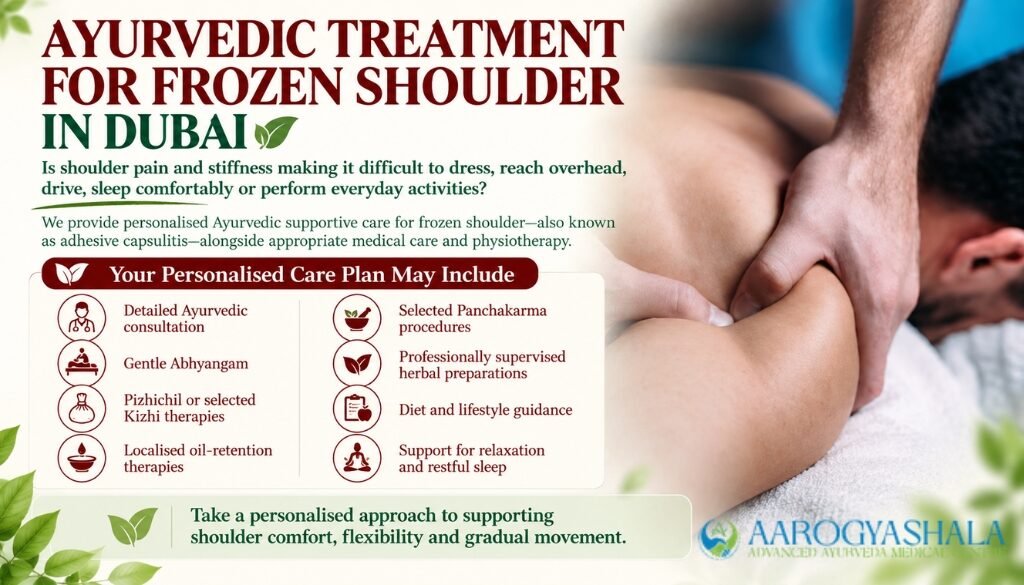
At Aarogyashala Advanced Ayurveda Medical Centre LLC, we offer personalised Ayurvedic treatment for frozen shoulder in Dubai as a complementary approach to medical care and physiotherapy. Our clinic is conveniently located on Mankhool Road in Bur Dubai, Dubai.
Every care plan is based on the patient’s symptoms, affected shoulder, range of movement, stage of the condition, pain level, body constitution, occupation, activity level, current medicines, previous injuries or surgery and complete medical history.
Ayurvedic care should complement—not replace—medical assessment, physiotherapy or treatment recommended by an orthopaedic specialist.
What Is Frozen Shoulder?
Frozen shoulder develops when the connective-tissue capsule surrounding the shoulder joint becomes inflamed, thickened and tight. This restricts movement and may cause significant pain and stiffness.
Unlike some other shoulder conditions, frozen shoulder usually limits both:
- Active movement: Movement performed by the patient
- Passive movement: Movement performed by a doctor or physiotherapist while the patient relaxes the shoulder
The condition usually develops gradually and may take months or sometimes years to improve. Recovery time varies, and some patients may not regain their complete previous range of movement.
The Three Stages of Frozen Shoulder
Frozen shoulder generally progresses through three overlapping stages. The duration and severity of each stage differ among patients.
1. Freezing stage
During the freezing stage:
- Shoulder pain gradually increases
- Pain may become worse at night
- Sleeping on the affected side may be difficult
- Shoulder movement becomes progressively restricted
- Reaching overhead or behind the back becomes painful
This is generally the most painful phase. Strong massage, forceful stretching and excessive heat may aggravate symptoms in some patients.
2. Frozen stage
During the frozen stage:
- Pain may gradually become less intense
- Stiffness remains or becomes more noticeable
- Shoulder movement is significantly restricted
- Everyday activities may remain difficult
- Muscle weakness may develop because the arm is used less
Movement and rehabilitation exercises may be gradually progressed under professional guidance.
3. Thawing stage
During the thawing stage:
- Shoulder movement gradually begins to improve
- Stiffness slowly decreases
- Pain usually becomes less troublesome
- Daily activities become easier
- Strength and flexibility may progressively return
Recovery is often slow. Regular, appropriate exercises remain important during this stage.
Frozen shoulder typically progresses through freezing, frozen and thawing stages.
Common Signs and Symptoms
The two main symptoms are pain and stiffness. Other symptoms may include:
- Pain around the outer shoulder or upper arm
- Pain that becomes worse at night
- Difficulty sleeping on the affected side
- Reduced ability to lift the arm
- Difficulty reaching behind the back
- Difficulty dressing or combing the hair
- Pain during sudden movements
- Restricted rotation of the shoulder
- Weakness caused by reduced arm use
- Difficulty performing household or occupational tasks
Frozen shoulder usually affects one shoulder, but some people may later develop symptoms in the opposite shoulder.
Possible Causes and Risk Factors
The exact cause is not always known. Frozen shoulder may develop without an obvious injury, or it may follow a period when the shoulder remained relatively immobile.
Risk factors include:
- Diabetes
- Thyroid disorders
- Previous shoulder injury
- Shoulder or breast surgery
- Prolonged immobilisation
- Rotator-cuff injury
- Arm fracture
- Stroke
- Cardiovascular disease
- Parkinson’s disease
- Age over 40
People with diabetes may experience more persistent or severe symptoms. Good management of blood sugar and other medical conditions is an important part of overall care.
Other Causes of Shoulder Pain and Stiffness
Not every stiff or painful shoulder is frozen shoulder. Similar symptoms may occur with:
- Rotator-cuff injury
- Shoulder arthritis
- Tendon inflammation
- Bursitis
- Calcific tendinitis
- Fracture or dislocation
- Neck or nerve problems
- Infection
- Referred pain from another part of the body
Patients seeking shoulder pain treatment in Bur Dubai should receive an appropriate diagnosis before beginning Ayurvedic therapy.
How Is Frozen Shoulder Diagnosed?
A doctor or physiotherapist may review the symptoms and examine:
- Active shoulder movement
- Passive shoulder movement
- Pain location and severity
- Shoulder strength
- Neck and nerve function
- Medical history
- Previous injuries or surgery
An X-ray, ultrasound or MRI may sometimes be recommended to exclude arthritis, rotator-cuff injury, fracture or another cause.
Frozen shoulder is often identified when both active and passive movement are significantly restricted.
Understanding Frozen Shoulder and Apabahuka in Ayurveda
In Ayurveda, a frozen shoulder-like presentation is often discussed in relation to Apabahuka. However, Apabahuka should not be considered an exact substitute for a modern diagnosis of adhesive capsulitis.
According to Ayurvedic principles, aggravated Vata may affect the structures and movement of the shoulder. This may be associated with pain, stiffness, dryness and restricted function. Other doshas may also be considered depending on the presence of heaviness, swelling, heat or inflammation.
An Ayurvedic assessment may review:
- Nature and location of the pain
- Range of shoulder movement
- Stage and duration of symptoms
- Presence of swelling or warmth
- Sleep disturbance
- Previous injuries or surgery
- Occupation and repetitive activities
- Body constitution or Prakriti
- Digestive health
- Current medicines
- Other health conditions
These traditional concepts help personalise supportive care but do not replace medical diagnosis or imaging.
How Ayurveda May Support Frozen Shoulder Management
Personalised Ayurvedic treatment for frozen shoulder in Dubai may be used alongside medical care and physiotherapy to support selected aspects of recovery.
Depending on the individual assessment, care may focus on:
- Supporting shoulder comfort
- Addressing the feeling of stiffness
- Promoting relaxation
- Supporting gradual movement
- Encouraging appropriate daily activity
- Supporting restful sleep
- Providing personalised diet and lifestyle guidance
- Helping manage stress associated with persistent pain
Ayurvedic treatment cannot guarantee immediate restoration of movement or complete recovery. Outcomes depend on the stage, duration and severity of the condition, underlying health problems, adherence to rehabilitation and individual response.
Personalised Ayurvedic Treatment for Frozen Shoulder in Dubai
Before recommending an Ayurvedic treatment for frozen shoulder in Dubai, the practitioner may review:
- Confirmed medical diagnosis
- Affected shoulder
- Range and direction of restricted movement
- Current disease stage
- Pain severity
- Previous injuries or surgery
- X-ray, ultrasound or MRI findings
- Physiotherapy programme
- Current medicines or injections
- Diabetes and thyroid health
- Occupation and daily activities
- Sleep and general health
This assessment helps determine which therapies may be appropriate and how they should be modified.
Ayurvedic Therapies That May Be Considered
The following therapies may form part of a personalised programme at our Ayurvedic clinic in Bur Dubai. Not every treatment is appropriate for every patient.
Abhyangam
Abhyangam is a traditional Ayurvedic oil application and massage. Gentle techniques may promote relaxation and support shoulder comfort in selected patients.
During the painful freezing stage, strong pressure or aggressive movements may increase discomfort and should be avoided.
Pizhichil
Pizhichil involves the controlled application of warm medicated oil with gentle therapeutic movements. It may be considered for selected patients depending on their symptoms and tolerance.
Kizhi
Kizhi uses prepared herbal bundles applied with controlled temperature and movement. The type of Kizhi should be selected according to the condition’s stage and the presence or absence of acute inflammation.
Nasya
Nasya involves professionally supervised nasal administration of a selected Ayurvedic preparation. It should only be recommended after an assessment and is not suitable for every patient.
Panchakarma
A Panchakarma treatment for frozen shoulder should not be presented as one standard programme. Selected procedures may be considered according to the patient’s constitution, strength, medical history and stage of frozen shoulder.
Ayurvedic Treatment for Shoulder Stiffness
An Ayurvedic treatment for shoulder stiffness should be adapted to the current stage of frozen shoulder.
During the painful freezing stage, the initial focus may be comfort and gentle movement within tolerance. During the frozen and thawing stages, therapies may be gradually combined with professionally guided mobility exercises.
Forceful massage or stretching does not necessarily accelerate recovery and may worsen pain. Treatment intensity should be increased only when appropriate.
The Role of Physiotherapy
Physiotherapy is an important component of frozen shoulder management. A physiotherapist can assess movement and recommend exercises suited to the disease stage.
Physiotherapy may involve:
- Gentle range-of-motion exercises
- Gradual stretching
- Posture correction
- Shoulder-blade control
- Strengthening when appropriate
- Advice about daily activities
- A personalised home-exercise programme
Physiotherapy can help patients recover shoulder movement.
Ayurvedic care should not be used as a reason to discontinue prescribed physiotherapy.
Exercise Without Forcing the Shoulder
Exercise should be gentle, progressive and appropriate for the current stage. General principles include:
- Move within a comfortable range
- Avoid sudden or forceful stretching
- Do not repeatedly push through severe pain
- Perform exercises recommended by a physiotherapist
- Increase repetitions gradually
- Stop if new weakness, numbness or severe pain develops
- Avoid prolonged complete immobilisation unless medically instructed
Pain levels should guide intensity. A small amount of discomfort may occur with stretching, but severe or lasting pain suggests that the exercise may be too aggressive.
Posture and Daily Activities
Poor posture does not directly cause every case of frozen shoulder, but prolonged awkward positions can increase neck and shoulder discomfort.
Helpful measures may include:
- Sit with the back supported
- Keep computer screens near eye level
- Avoid holding the phone between the neck and shoulder
- Take regular breaks from desk work
- Avoid carrying heavy bags on the affected side
- Keep frequently used items within easy reach
- Use both hands when lifting
- Avoid sudden overhead movements
- Support the arm comfortably while resting
An individual programme for natural frozen shoulder management in Dubai should consider the patient’s workplace and daily tasks.
Sleeping With Frozen Shoulder
Night pain is common, particularly during the freezing stage. Patients may find it helpful to:
- Avoid sleeping directly on the painful shoulder
- Place a pillow beneath or in front of the affected arm
- Maintain a comfortable neck position
- Follow prescribed pain-management advice
- Use heat or cold only when recommended
- Avoid aggressive exercises immediately before bed
Persistent night pain should be discussed with a doctor.
Diet and Lifestyle Guidance
No specific diet can cure frozen shoulder. Balanced nutrition may support general health, muscle strength and management of diabetes or body weight.
General guidance may include:
- Eat regular, balanced meals
- Include vegetables, fruits and whole grains
- Consume suitable sources of protein
- Maintain adequate hydration
- Limit heavily processed foods
- Avoid smoking
- Limit alcohol
- Maintain a healthy weight when appropriate
- Manage diabetes and thyroid conditions
- Follow a regular sleeping schedule
People with diabetes should continue medical monitoring and prescribed treatment because blood-sugar management is relevant to overall recovery.
Benefits of Personalised Ayurvedic Care
Possible benefits of personalised Ayurvedic care for Apabahuka include:
- Detailed assessment of pain and movement
- Treatment adapted to the disease stage
- Consideration of body constitution
- Professionally selected therapies
- Integration with physiotherapy
- Diet and lifestyle guidance
- Support for relaxation and sleep
- Review of current medicines
- Ongoing monitoring and adjustment
- Avoidance of unsuitable heat or pressure
No treatment outcome can be guaranteed.
Why Choose Aarogyashala in Bur Dubai?
Aarogyashala Advanced Ayurveda Medical Centre LLC provides personalised Ayurvedic care in a professional and welcoming environment in Bur Dubai, Dubai.
Patients seeking frozen shoulder treatment in Bur Dubai may choose Aarogyashala for:
- Individual Ayurvedic consultation
- Stage-specific treatment planning
- Traditional therapies under professional supervision
- Coordination with recommended physiotherapy
- Personalised diet and lifestyle guidance
- Consideration of medical reports and medicines
- Convenient location on Mankhool Road
- Easy access from Sharaf DG Metro Station—Exit 2
- Follow-up according to individual progress
If you are searching for an Ayurvedic doctor for frozen shoulder in Dubai, our team can evaluate your symptoms and recommend suitable complementary care after consultation.


Frequently Asked Questions